About the Yamaha XS-Eleven
Based on decades in the business, we consider the XS11 the best motorcycle of its era. Here's why.
These — in my opinion, based on 32 years in the motorcycle business (now 37) — are the best motorcycles of all time. Yes, that's a broad statement, and a lot of people have said it before, all of them manufacturers. I'm not a manufacturer, I'm a remanufacturer. I've had the choice of being more objective, however, than they have. Not only that, I ceased being a Yamaha dealer in 1982 in less than a favorable position in their eyes. They sued me and even tried to put me in jail. Fortunately it never worked out for them.
Even that didn't dissuade me in the case of the XS11 and several other bikes that they made. The facts are still the facts. After being an independent dealer for 18 years and servicing all four Japanese brands, I've had ample opportunity to compare most of them rather carefully. I just became more and more convinced the XS11 had more to offer than any other bike. It is simpler, more efficient, easier to service and work on. It has longevity, high performance, and good looks. The bike is super strong and can hold up in crashes that would easily total most other motorcycles. A few minor additions to suspension, a fork brace, and the handling is superb for a big bike. It will carry more than the Gold Wings of its day and is a lot faster.
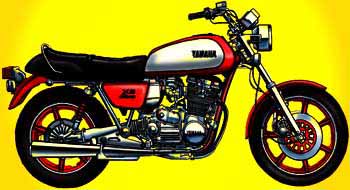
Engineering — Shaft Drive & the Drivetrain
The unique right-angle shaft drive is not the only reason the bike didn't have a torque reaction. The four-cylinder engine was built to do that from the first day of its conception. The other big Japanese four cylinders were chain-drive engines with a shaft simply added on via a gearbox at the back of the engine, or attached where the chain sprocket was with screws. They all worked fairly well, but they were no XS11. The other cranks rotate forward. On the XS11, it turns towards the rear, putting engine torque down into the rear wheel and creating the best power transfer to the ground of any bike. Power take-off is at the center of the crankshaft through the straight-cut gears to a ten-row Hyvo chain and onto a jackshaft housing a device to remove shock from the drivetrain. This short shaft allows the clutch to be mounted closer to the centerline of the bike, resulting in better balance and handling at low speeds.
Air-Cooled Simplicity
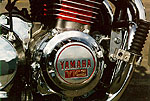
It's air-cooled too. No radiator, hoses, o-rings, pumps, fans, switches, sensors or antifreeze — that slick green stuff that leaks out of all that paraphernalia after a few years or tune-ups. And if you're unlucky enough, it ends up on your rear tire. Then you will wind up on the ground. Not me, boy, I don't want any water-cooling. Too complicated.
Oh, I know you've heard the engine lasts longer with water-cooling. Well, if it does then it's irrelevant and immaterial. I've got 203,000 miles on one of my three XS11s. Anyone can go 50,000 on a clutch, 75–100,000 on a valve job and 200,000 on a crank. The average person rides 2,000 miles per year and, if you add a long road trip, 5,000. Let's face it, they're toys, not cars. Multiply 20 years and that's 100,000 miles. That means the XS11 would last the average rider 40 years. I just can't imagine why anyone would want to fuss with water-cooling with all its mess, complication and costly repairs — not to speak of the danger factor again.
A good design is simplicity. When you can have that and power, versatility and handling too, well, I think that's the ultimate — and that's the XS11. They also have one of, if not the best, charging systems ever on a motorcycle. It's rare for one to ever fail. I've seen maybe three or four in 20 years. And I can fix one if it ever does fail.
The Second-Gear Fix
The notorious second-gear problem in the transmission is something Yamaha did wrong. There's a spacer in the wrong place. This puts the second-gear wheel too far from the fifth-gear wheel that engages it to make second-gear shift. In normal driving there's never a problem; however, when drag racing and snap-shifting with this big power plant making nearly 100 horsepower at 66 ft-lbs of torque, second gear needs to lock in as far as possible. Unfortunately, with the factory spacer it can't. If the spacer is put on the shaft first, then the gear afterwards, it will allow second to fully seat and the transmission problem will cease to exist.
Since all the books and microfiche show it wrong, everyone has always put it back on wrong. If you're a regular rider, this presents no real problem, but for power racers and aggressive riders it will cause the second-gear dogs to wear out. We know the fix, and we do it right on every bike we work on.